The trading journal
The journal that coaches you back.
Log a demo trade once and the journal reads the habits behind it — the overtrading, the hesitation, the setups you talk yourself out of. The patterns you can't see get named early, on purpose, and read back to you by a mentor each week.
How the journal supports your practice
Record your demo practice
Bring your entries and reflections into one record, while the decisions are still fresh.
Notice recurring patterns
Explore the habits behind your entries, from hesitation to the consistency of your routine.
Review with your mentor
Use your weekly review to discuss what changed and what to practise next.
Explore an illustrative psychology map using fictional demo-journal entries. Hover or tap a node to discover a pattern, then select it to read the example evidence behind it. Your own journal gives your mentor a starting point for review.
Choose a pattern above or select a node to read its example journal entries.
This week in the brain
This week's focus — pick one node
Make-up trading. Step away after a setback rather than reaching to win it back — and no entries to "catch up" on a missed session. Your mentor sees this too.
Learned from
16 decisions
2 demo accounts · counts are decisions, not rows
Educational example — a synthetic student's demo journal. The entries, patterns and actions shown here are illustrative; no mentor is notified.
See it for yourself
The whole journal, one screen at a time.
The screens a Stage-3 student actually lives in, captured from the real product on demo data. Switch between them — they're stills, and they're honest about being stills.
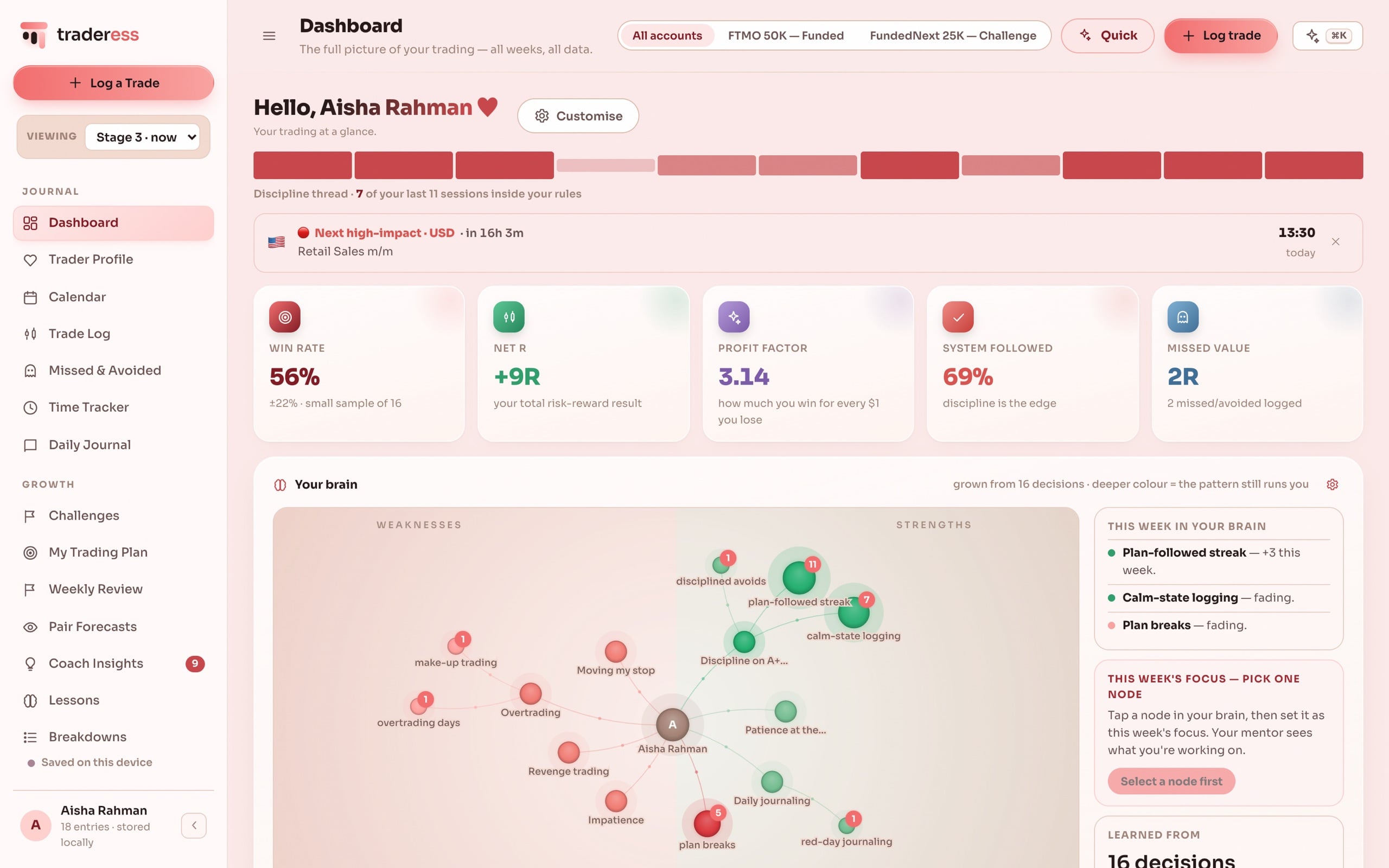
Demo data throughout — one fictional student. Nothing here is a real account.
The dashboard
The first thing you open each morning: your demo week read back in the numbers that matter, not the ones that flatter. Consistency, setup quality, the habits you're building — all in one glance before you place a single entry.
This is a still. The living version — your numbers, your patterns, your habits named out loud — is something we walk through together.
Patterns worth noticing
Understand the habits behind your decisions.
These are eighteen examples of the behaviour patterns the journal helps you review. They turn a collection of demo entries into focused questions for your next mentor session.
- System-adherence edge
- Revenge trading
- Overtrading
- Size creep after red days
- Cutting winners early
- Red entries past your own line
- News-window discipline
- Low-quality setups taken
- Session edge
- Weekday edge
- Confirmation-depth edge
- Forecasting edge
- Stress-day performance
- FOMO in your own words
- Hesitation language
- The cost of missed winners
- Streak overconfidence
- Journalling habit trend
On your trading-plan call, we can walk through how the journal supports demo practice and how your mentor uses that record with you.
What's inside
Built for the way a trader actually works.
Keep your demo entries, reflections and weekly reviews together, so you and your mentor can work from the same evidence.
Bring your old spreadsheet
MT5, cTrader, a Google Sheet, an old academy tracker — the importer reads them the way a person would, and your history arrives already tagged. No re-typing a single trade.
Quality scoring
Every evaluation is scored 0–100 against a mentor-calibrated rubric, so “a good week” stops being a feeling and becomes a number you can actually move.
Calendar heatmap
A month at a glance, every day tinted by how it went. The shape of your consistency, visible from across the room.
Weekly review
The journal drafts your week-versus-week review for you — what changed, what held, what slipped — and you finish it in minutes instead of dreading it.
Missed & avoided
The trades you didn't take count too. The setups you watched go by and the ones you wisely left alone both go on the record.
Time tracker
Charts your screen time against your journalling time against the videos you actually watched — measured against your weekly targets, not your good intentions.
Seasonal challenges
Monthly commitments you set for yourself — the kind that are easy to make and quietly dropped by week two — that track themselves and tell you honestly whether you kept your word.
The challenge business, run like a business
The prop-firm pipeline and scaling lab in one place: track each attempt from first target to verification cleared, and plan the next step like the operation it is.
The point of all of it
Make your next review more useful.
Arrive with a clear record of what you practised, what felt difficult and what changed. Your mentor can help turn that evidence into your next step.
Every screen here shows demo data from a fictional student. Traderess is an educational programme, not financial advice — results are never typical or guaranteed, and trading involves significant risk.